The Grab teardownwhat we are cloning — and what we already know it earns
Grab is four consumer verticals run as one marketplace with three apps: consumer, driver, merchant. FY2025 was its first full profitable year — $3.37B revenue, $200M profit, $22.1B GMV, 50M+ monthly users across 8 countries. The raw scrapes and financials live in the research appendix.
The money, in one table
| Lever | Rate / figure | Note |
|---|---|---|
| Mobility commission | 16–25% | SG moved fixed 20.18% → dynamic, Nov 2024 |
| Food & mart merchant fee | 30% SG | 15–30% regional; + activation S$100–300 |
| Net take after incentives | 15.4% / 11.8% | mobility / deliveries share of GMV |
| Incentive spend | ~10% GMV | $2.3B in 2025 — the discipline line |
| Segment EBITDA | 8.7% / ~2% | mobility is the profit engine; food is thin |
| Payment gateway fees | 3.3–3.4% | +S$0.50 per card transaction |
The sequencing playbook
- Start with incumbent supply, not against it. MyTeksi digitised street taxis first — instant fleet, regulator goodwill — then layered private hire and merged the queues.
- Solve the local problem. Cash from day one, bikes for gridlock, alleyway maps, local language. This is precisely how Grab beat Uber.
- Climb the frequency ladder. Taxi (weekly) → food (daily) → payments (many times daily). Each rung drops the next vertical's acquisition cost toward zero.
- Payments is the keystone. Wallet before food; float and transaction data become the underwriting moat.
- Safety is the brand. The founding story and the feature drumbeat are what regulators and families trust.
- Own your cost curves at scale — maps, fraud — then sell them.
What Grab's own users hate — our product law
Mined from 2024–26 reviews of all three apps: cancellation traps with popups over the cancel button, bot-only support, ETAs that never update, ads at the booking moment, far-driver dispatch, driver-app popups covering navigation, merchant auto-pause and 38% effective take when promos stack. Every one becomes an explicit commitment in chapter 3.
The Malé realitywhere we launch — fixed fares, broken supply, fresh payment rails
Greater Malé is a quarter-million-person conurbation on three islands and a bridge, with 84.7% internet penetration, a motorcycle-to-car ratio of 15:1, and taxi fares fixed by law. That last fact defines the strategy: nobody can compete on price — only on reliability, coverage and payment convenience.
Statutory taxi fares (in force, May 2024 schedule)
| Route | Car <6 seats | Van 7–10 |
|---|---|---|
| Within zone (Malé · HM P1 · HM P2) | MVR 30 | MVR 45 |
| Malé ↔ Hulhumalé Phase 1 | MVR 85 | MVR 130 |
| Malé ↔ Hulhumalé Phase 2 | MVR 100 | MVR 155 |
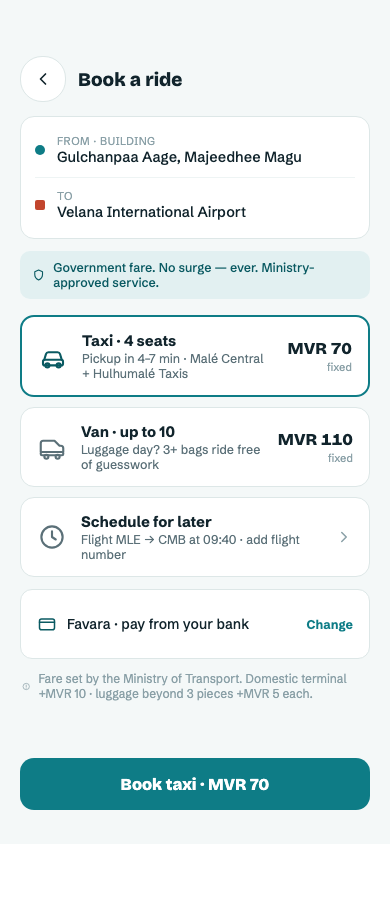
| Malé ↔ Velana Airport | MVR 70 | MVR 110 |
| Hulhumalé P1 ↔ P2 | MVR 40 | MVR 60 |
| Airport ↔ Hulhumalé P1 | MVR 80 | MVR 125 |
| Airport ↔ Hulhumalé P2 | MVR 85 | MVR 130 |
| Domestic terminal surcharge | +10 | +15 |
| Luggage | first 3 items free · +MVR 5 per additional item | |
Who is already here
Payments: the rails just arrived
- Favara — MMA instant-payment system (2023), all banks on by Jan 2025; Favara Request is push-collection that replaces the national habit of "BML transfer + screenshot".
- PayMV QR — the national QR standard, run by Payment Maldives Pvt Ltd with Favara and the ACH. A merchant-payments enabler nobody has bundled yet.
- BML — the only local 3-D Secure gateway (Mastercard MPGS); Apple/Google Pay POS acceptance exists.
- Licensing gate — any stored-value wallet needs an MMA PSP/e-money licence (NPS Act 17/2021). Path: launch on gateway + Favara Request, license or partner for the wallet. GATE
Regulation that shapes the build
- Taxi apps need prior written Ministry approval (Taxi Regulation R-132/2022): mandated tracking, ratings, e-receipts, multi-payment — and a live Ministry dashboard (trips, km, 6-month driver histories). A launch blocker by law; we build it as a first-class module. History sharpens this: in 2019 the Ministry approved exactly three apps (Avas Ride, PickMe, E'AEE) and made one mandatory — so whether a new entrant gets authorised is the first question to put to the Ministry, before engineering. GATE
- No surge, ever — fares are state-fixed. Incentives come from our margin.
- No bike-taxi vertical — the regulation is written for cars only. Motorcycles are the delivery fleet.
- Data protection bill in committee — accepted by Parliament 66–0 on 22 Jun 2026; treat GDPR-grade practice as arriving, not optional.
MODELLED Greater Malé pools (order-of-magnitude): rides GMV USD 13–26M/yr, food GMV USD 13–23M/yr. No single vertical closes the case — the bundle is the business, exactly as Grab's P&L teaches.
Product in four phasesrides first, then the bundle — with commitments Grab won't make
Foundations
First act: put the licence question to the Ministry — one meeting resolves the largest binary risk. Then company + licences, taxi-centre partnerships, approval with dashboard demo, BML + Favara integrations, building-name gazetteer for Malé.
Rides, then food, Greater Malé
Taxi hailing at statutory fares via 2–4 partnered centres; airport corridor focus; then restaurant delivery on an own motorcycle fleet. Cash, card (3-DS), Favara Request.
The bundle
Express parcels with photo proof and ferry drop-off to the atolls; Mart; stored-value wallet under an MMA-licensed partner; delivery subscription; coins.
The platform
Boats tile (RTL / Odiapp / Dhathuru aggregation), Addu and the northern cities, tourist mode, merchant lending on order-flow data, sponsored listings.
Better than Grab — commitments, not slogans
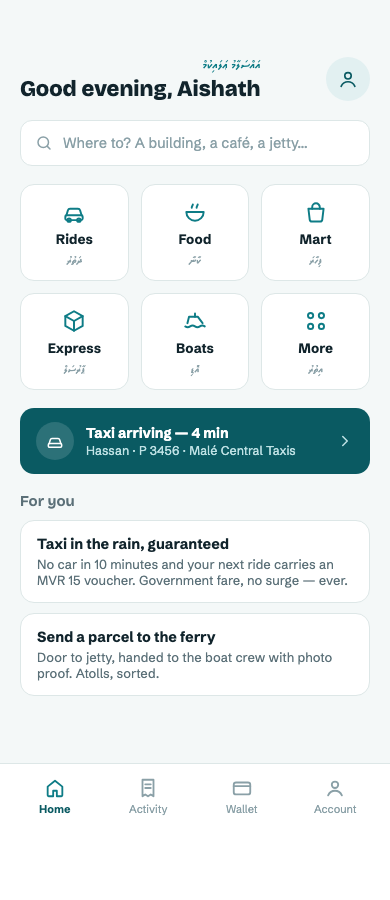
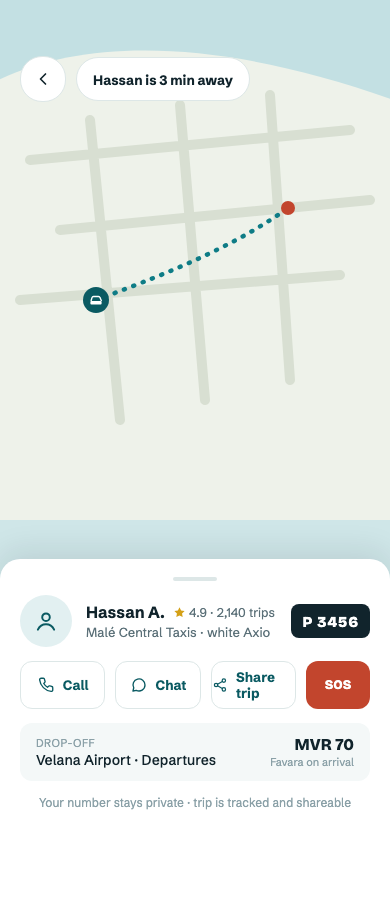
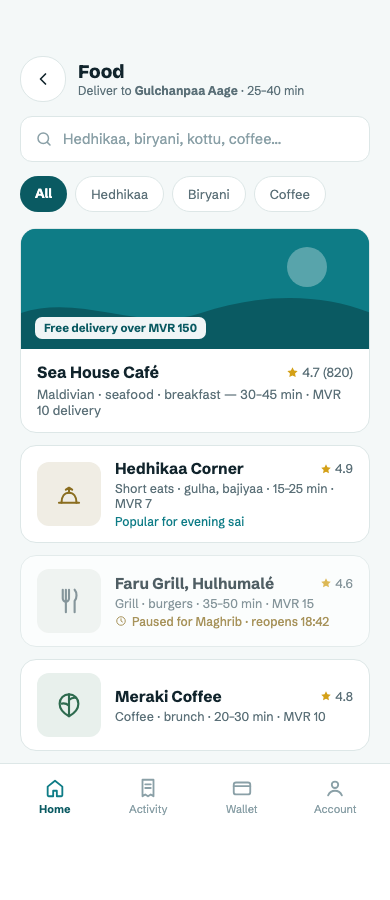
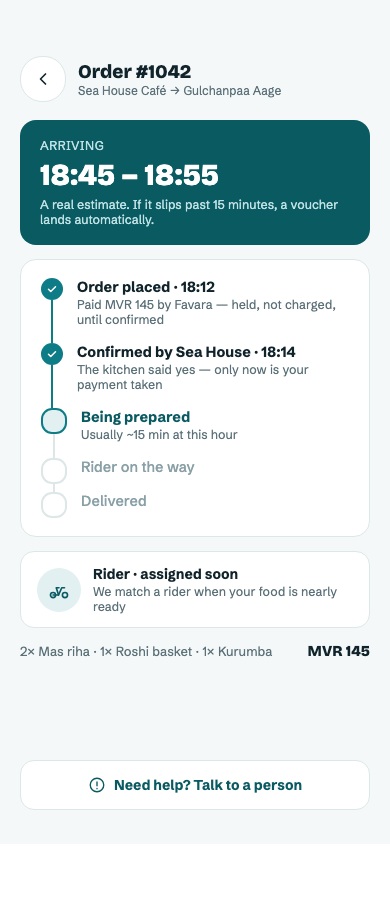
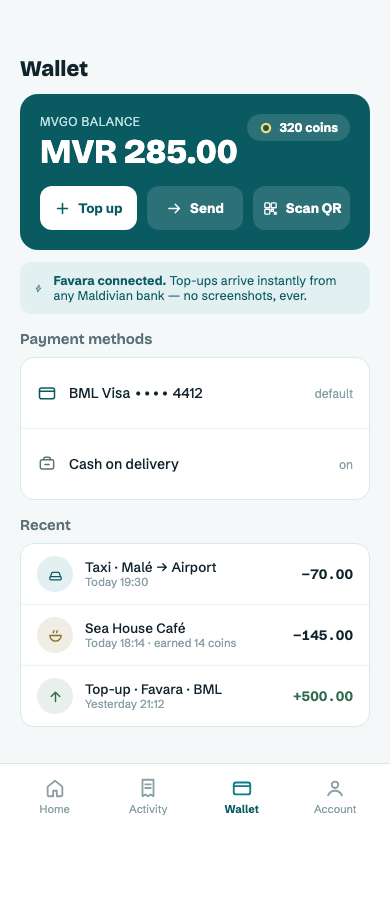
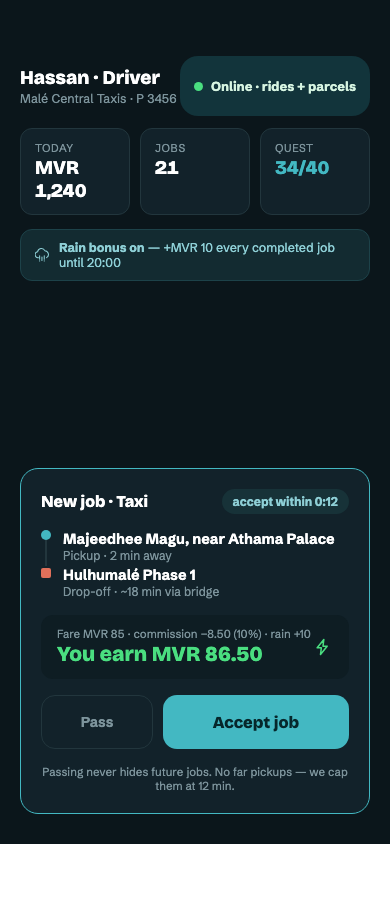
The screensthe committed direction — every chapter-3 promise visible on-screen
Lagoon teal on foam white, sea-ink dark for the driver app; Bricolage Grotesque + Schibsted Grotesk + Noto Sans Thaana. Dhivehi strings pending native review. Tap any screen for full size.
Plan & economicssupply first, one wedge message, honest numbers
Supply first — it is the hard part
- Taxi centres (50-vehicle minimum entities): free dispatch tech, pooled demand, instant payouts, human support. Commission 10% intro → 15% standard — under the Grab norm, because fixed fares mean the passenger side cannot be taxed.
- Riders: recruit the existing café in-house fleets and expat workforce; per-drop + distance + quests; rain bonuses funded from margin.
- Merchants: attack the undigitised Viber/Instagram long tail with 0 activation, 15/8/0 fees and next-day Favara settlement.
The wedge
"Taxi in the rain." One promise — a car in 10 minutes or a voucher — aimed at the single most documented complaint in Malé, plus the airport corridor where refusals and overcharging are most visible.
Year-1 model MODELLED · UNDER REWORK
REV 0.2 The outside review correctly found missing lines: rider-fleet cost (MVR 5–8.5M/yr), GST, a bridge for the food revenue figure, unpriced service commitments, and an unstated capital source (~USD 1.6–2.3M). The rebuilt model ships in the next revision; the table below is the uncorrected original, kept for comparison.
| Line | Assumption | Result / yr |
|---|---|---|
| Rides commission | 3,000 trips/day · 12.5% | ≈ MVR 6.8M |
| Food revenue | 1,500 orders/day · 15% + fees | ≈ MVR 18.6M |
| Burn (team, incentives ≤10% GMV, infra, marketing) | — | MVR 25–35M |
| Breakeven | bundle + wallet attach | credible year 3 |
Top risks
- Ministry approval slips → engage pre-build; food can launch first while rides pend.
- Incumbent fast-follow (Avas price cuts, Foodies wallet) → win on bundle + service, not price.
- Wallet licence delay → Favara Request carries the loop meanwhile.
- SOE politics → offer Malé Taxi Line integration rather than war.
Compliance gatesthe ten approvals that sequence everything
| # | Gate | Instrument | Blocks |
|---|---|---|---|
| R1 | Company / FI structuring | FI Act 11/2024 · Companies Act 7/2023 | everything |
| R2 | Taxi app written approval + dashboard demo | R-132/2022 · App Standard 35(b) | rides |
| R3 | Taxi-centre contracts | centre licensing (≥50 vehicles) | ride supply |
| R4 | Card acquiring | BML MPGS 3-DS agreement | card payments |
| R5 | Favara Request / PayMV QR | partner bank / PSP | push payments |
| R6 | Food-permit verification SOP | MED + health permits (confirm locally) | food |
| R7 | PSP / e-money licence or partner | NPS Act 17/2021 (MMA) | wallet |
| R8 | Rider / parcel insurance partner | local insurers | express |
| R9 | Privacy programme | PDP Bill (pending) — GDPR-grade now | continuous |
| R10 | Tourist USD flows | Foreign Currency Act 32/2024 | tourist mode |